
Selling a House After the Death of a Spouse or Family Member in Albuquerque
Losing a spouse, a parent or another family member is hard enough without having to decide what happens to the house. Maybe it is the home you shared for decades, a parent's house that has been sitting empty, or a property several siblings now own together, and you are not sure who can sign or where to start.
Whether the house is in Albuquerque, Rio Rancho, the East Mountains, Valencia County or elsewhere in New Mexico, questions like whose name is on the deed, whether probate is needed, who keeps paying the mortgage and taxes, and what to do with a lifetime of belongings can make the next step hard to see. There is no need to rush. Knowing how these pieces work helps you choose between keeping the house, fixing it up and listing it, or selling it as-is for cash when the family is ready.
This guide explains:
✅Surviving spouse and community property basics
✅Joint tenancy and transfer on death deeds
✅When probate is needed and who can sign
✅The mortgage, property taxes and insurance
✅Belongings, cleanout and an empty house
✅When heirs disagree about the house
✅How our in-person process works
Lost a Loved One? Let's Look at Your Options for the House.
Whether you are a surviving spouse, an adult child, a sibling or the personal representative of an estate, we'll walk through your options at your pace and help you understand your next steps. There is no pressure to decide anything on the first call.
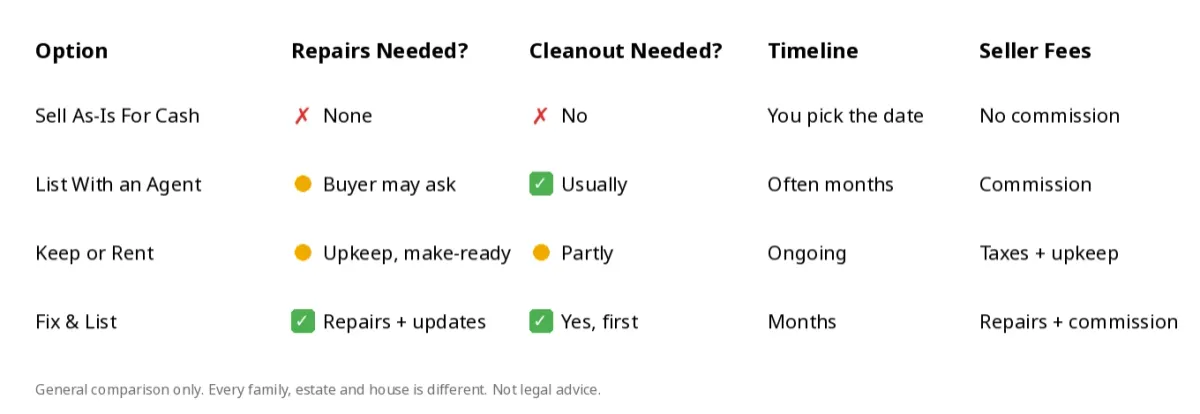
Options for the House After a Spouse or Family Member Dies
Some families keep the house, move into it or rent it out. Others clean it out, make repairs and list it with an agent. Some decide the upkeep, repairs and cleanout are more than they want to take on while grieving. Before you decide, it helps to know the options you may have.
1. Find Out How the House Was Owned
Before anything else, look at the deed. Whether the house was owned by one person, by a married couple as community property, in joint tenancy, with a transfer on death deed, or in a living trust decides who owns it now and whether probate is needed before it can be sold.
Papers families often gather:
- The recorded deed and any transfer on death deed
- Several certified copies of the death certificate
- The will or trust, if there is one
- Recent mortgage statements and property tax bills
2. Clean Out, Repair and List
Some families choose to:
- Sort, donate and remove belongings
- Paint, replace flooring and update the kitchen
- Repair the roof, plumbing, heating and cooling
- Stage the home and list it on the MLS
Getting the house ready can bring a higher listing price, but cleanout, repairs, showings and buyer inspections take time and money, and someone has to keep paying the mortgage, taxes, utilities and insurance until it closes.
3. Keep the House or Sell It As-Is
Some families decide what to do with the house based on things like:
- A surviving spouse who wants to stay, or to move closer to family
- Heirs who live out of state
- An older house that needs more work than the family wants to take on
- Siblings who want to split the value fairly
4. Legal, Title & Probate Help
If the house is still in a late owner's name, there is no will, or family members disagree, a New Mexico attorney can help you understand your rights, probate and the title. This page is general information, not legal advice.
Helpful Resources:
How the House Passes in New Mexico: Spouse, Joint Tenancy & TOD Deeds
New Mexico is a community property state. A home bought during the marriage is usually community property, and when there is no will, the late spouse's half generally passes to the surviving spouse. A will can leave that half to someone else, and a house one spouse owned before the marriage or inherited may be separate property. If the deed lists the owners as joint tenants, the survivor usually owns the house without probate. If the owner recorded a transfer on death deed, the house passes to the named beneficiary without probate. If the house is in a living trust, the successor trustee can usually sell it under the trust's terms.
Typical steps:
- Get certified copies of the death certificate
- Pull the recorded deed and see how title was held
- For joint tenancy, record an affidavit of the surviving joint tenant with the county clerk
- For a transfer on death deed, record the death certificate and the needed affidavit
- If there is no such deed, check whether probate is needed
- Open title with a title company before you sign a sale contract
New Mexico law on transfer on death deeds (Uniform Real Property Transfer on Death Act):
NM Legislature: Transfer on Death Deed Act (SB 107, 2013)
Recording an affidavit, a death certificate or a deed in Bernalillo County:
Bernalillo County Clerk: Recording & Filing
Official New Mexico probate forms, including informal probate:
How Long Does It Take To Sell a House After a Death?
Every family is different. A surviving spouse who already owns the house through joint tenancy can often sell within weeks once the affidavit is recorded. When probate is needed, the sale usually waits until a personal representative is appointed, and the whole process can take months. In New Mexico, an informal probate generally cannot be opened until 120 hours after the death, and usually within three years.
Some sales move faster when:
- The deed already names a surviving joint tenant or a TOD beneficiary
- A personal representative has already been appointed
- All the heirs agree on selling
- No probate or title issues exist
Sales can take longer if there are:
- No will, or a will no one can find
- Heirs who live out of state or cannot be reached
- Family members who disagree about selling or price
- A deed still in the name of someone who died years ago
- Unpaid property taxes or old liens
- A full house of belongings to sort through
- Repairs the house needs before it can be listed
The Mortgage, Property Taxes & Insurance
A mortgage does not go away when the borrower dies, but a surviving spouse or a relative who inherits the house is usually protected. Under the federal Garn-St Germain Act, a lender generally cannot call the loan due just because the house passed to a spouse or relative at death, and federal servicing rules let a confirmed successor get information about the loan. Keep making payments if you can, and send the servicer a copy of the death certificate. Property taxes still come due; in Bernalillo County they are billed by the Treasurer in two halves each year. Also tell the insurance company the owner has passed away, because many policies limit coverage when a house sits empty.
If payments have fallen behind, selling before foreclosure may protect the estate's equity.
What families often need to check:
- The mortgage balance, payment due date and any reverse mortgage
- Property taxes owed and when the next half is due
- Homeowners insurance and any vacancy limits on the policy
- Utilities that should stay on to protect the house
If the house is behind on property taxes, the unpaid amount is typically paid from the sale at closing.
Our New Mexico foreclosure guide explains the timeline if the lender has started foreclosure.
Helpful local resources:
Federal Garn-St Germain Act (12 U.S.C. 1701j-3)
Can You Sell an Inherited House As-Is?
In many cases, yes.
Some New Mexico families choose a direct cash sale in order to:
- Skip repairs and updates on an older house
- Leave behind the belongings they do not want to keep
- Avoid months of mortgage, tax and utility payments
- Avoid showings, buyer inspections and loan approval
- Split the proceeds between heirs and move on
Selling may still be possible even if:
- The deed is still in the late owner's name
- Probate has not been opened yet
- The house is full of furniture and belongings
- The house needs major repairs
- Property taxes are behind
- Some heirs live out of state
We meet sellers in person at their homes, and we can walk through the house with the family before probate or the title paperwork is finished. Nothing closes until the person signing has legal authority.
For more, see our page on selling an inherited house in Albuquerque.
When Probate Is Needed & Who Can Sign
Probate is usually needed when the house was in the late owner's name alone, with no surviving joint tenant, no transfer on death deed and no living trust. It is also common when a will leaves the house to several children or when there is no will at all.
Common issues include:
- No will, so New Mexico law decides who the heirs are
- Multiple heirs
- A will that names a personal representative who does not want to serve
- An heir who cannot be found or will not respond
- Deceased owners still on title
In New Mexico, a personal representative appointed by the court usually has authority to sell the house, and the title company will ask for the letters testamentary or letters of administration. Uncontested informal probates are often handled in the county Probate Court; formal or contested cases go to District Court. Some surviving spouses can use simpler steps for community property. Talk with a New Mexico attorney about your specific estate.
Helpful resource:
Belongings, Cleanout & Family Decisions
Before the house is sold, families usually think about:
- Keepsakes, photos and papers to save first
- Wills, deeds, titles and bank statements found in the house
- Furniture and items to divide between family members
- What to donate, sell or leave behind
- Medications, jewelry or valuables that need care
- Mail forwarding and canceling services in the late owner's name
- Checking on an empty house every week or two
Common sources of stress between family members include:
- Siblings who disagree about keeping or selling
- One heir living in the house while others want to sell
- Who pays the mortgage, taxes and repairs in the meantime
- Disagreements over the price or the timing
- Heirs far away who cannot help with the cleanout
- Not knowing what the house is worth as-is
Dealing with a full or hoarded house? You can sell it without a cleanout.
Fix and List, Keep It, or Sell As-Is for Cash?
Cleaning out the house, making repairs and listing on the MLS can bring the highest price, but it usually means you:
- Sort and remove a lifetime of belongings first
- Pay for repairs and updates up front
- Keep paying the mortgage, taxes, utilities and insurance
- Pay a listing commission when it sells
- Wait for a buyer, inspections and loan approval
Keeping the house or renting it out is another path, though it means ongoing upkeep and someone has to manage it. A direct cash sale trades some of the top price for speed and certainty: no repairs, no cleanout before you sell, no showings, no waiting on a buyer's loan, and a closing date the family chooses.
Ethan is also a licensed New Mexico real estate broker, so he can walk you through each path and help your family decide which one fits.
Albuquerque & New Mexico Resources for Families
Courts, county offices and legal help families may contact:
Probate: New Mexico Courts Probate Forms · Bernalillo County Probate Court
County Clerks (recording): Bernalillo County · Sandoval County
Legal help: State Bar of New Mexico · New Mexico Legal Aid
Important Reminder
Every family and every estate is different.
How the house was owned, whether there is a will, the mortgage, property taxes, the condition of the house and how many heirs are involved can all affect your price, timeline and options.
There is no need to rush, but the earlier a family reviews its situation, the more options it may have available.
FAQ
Can I sell my house after my spouse dies in New Mexico?
Usually, yes. If you owned the house as joint tenants, you record an affidavit of the surviving joint tenant and a death certificate with the county clerk, and then you can sell. If it was community property or in your spouse's name, the will, the deed or a simpler surviving spouse process may decide the next step. A title company or attorney can confirm what your house needs.
Do I need probate to sell an inherited house?
Not always. A house held in joint tenancy, passed by a transfer on death deed, or held in a living trust can usually be sold without probate. If the house was in the late owner's name alone, probate is usually needed so a personal representative can sign. Many New Mexico estates use informal probate. An attorney can tell you what applies to your family.
What happens to the mortgage when the owner dies?
The loan stays in place and is paid from the sale proceeds at closing. Federal law generally keeps a lender from calling the loan due just because the house passed to a spouse or relative. Keep making payments if you can and let the servicer know about the death.
Do I have to clean out the house before selling?
No. When we buy a house as-is, the family takes the keepsakes and items it wants, and whatever you leave behind can usually stay with the house. We can wait while you go through things at your own pace.
What if my siblings and I disagree about selling?
That is common. Usually every owner or the personal representative must sign, so it helps to get a clear picture of the options and an as-is value everyone can look at. If you cannot agree, a New Mexico attorney or a mediator can help. We are happy to meet with the whole family.
How does your process work for an inherited house?
Call (505) 300-2234 or send us the address. We meet sellers in person at their homes, so Ethan meets you at the house, looks it over and goes over your numbers and options. You don't need to fix or clean out anything first. If a cash sale fits, the family chooses the closing date.
How long do we have to open probate in New Mexico?
Generally up to three years after the death. New Mexico's court self-help guide says probate can be filed from 5 days to 3 years after death, in the county where the person lived. After three years, a limited proceeding is still available to transfer title to real estate to the heirs, but the personal representative's powers are narrower.
Can the personal representative sell the house before probate is closed?
Yes. Once appointed, a New Mexico personal representative has the same power over estate property that an owner would have and can sell real estate without notice, a hearing or a court order, unless the will or a court order limits that power. The sale is done with a Personal Representative's Deed. Title companies sometimes ask for extra court paperwork, so check with them early.
What if the house had a reverse mortgage?
Most reverse mortgages are FHA-insured HECMs. After the last borrower dies, and if there is no eligible non-borrowing spouse, the loan becomes due. Heirs generally have 30 days after the lender's due and payable notice to decide, and the lender may extend that to up to six months while the house is being sold. If the house is worth less than the balance, heirs can sell for at least 95 percent of the appraised value and the FHA insurance covers the rest. Contact the servicer right away.
Will we owe taxes when we sell the inherited house?
New Mexico does not have an inheritance tax, and its estate tax was phased out as of January 1, 2005. For federal income tax, an heir's basis in an inherited house is generally its fair market value on the date of death, so selling close to that value usually means little or no taxable gain. A tax professional can tell you what applies to your family.
Who pays the property taxes, insurance and utilities while the house sits?
The estate or the new owners do until the house is sold. Keep the property taxes, insurance and utilities current, and tell the insurance company the house is vacant, since some policies limit coverage for vacant homes. Unpaid taxes and bills are typically paid from the sale proceeds at closing.
Can the sale work if some heirs live out of state?
Yes. Many families have heirs outside New Mexico. Ask the title company about mail-away or remote signing so not everyone has to travel to Albuquerque, while a local family member or the personal representative meets Ethan at the house. Call (505) 300-2234 to set up a visit.
Ready To Talk About the House?
If you have lost a spouse or family member and are dealing with an inherited house, probate, a mortgage, a full house of belongings or family decisions, understanding your options early can make things a little easier.
Some families choose to:
- sell without making repairs
- skip the cleanout before selling
- avoid more mortgage, tax and upkeep payments
- split the proceeds between heirs
- avoid showings and waiting on a buyer's loan
- sell as-is for cash on their own timeline
Every situation is different, especially when probate, a will, a mortgage or several heirs are involved.
Ready To Sell Your House Fast In Albuquerque?
Get a fair cash offer from a local Albuquerque home buyer.
No pressure. No obligation.
Follow Us


Other
We Help With
We Buy Houses In
This is not legal, financial, or tax advice. For specific answers tailored to your situation, we always recommend consulting your trusted professionals. Some members of NM Cash Offer LLC are licensed real estate brokers in the State of New Mexico. NM Cash Offer LLC does not represent any Sellers in this transaction unless a separate written listing agreement is executed. Click to see Broker Disclosure.
© Copyright 2026 NM Cash Offer LLC. All Rights Reserved.