
Selling Your House When You Are Behind on the Mortgage in Albuquerque
Falling behind on a mortgage usually starts quietly: one missed payment, a late fee, then a second payment you can't quite cover. The Consumer Financial Protection Bureau says that if you can't pay your mortgage, or are worried about missing a payment, you should call your mortgage servicer right away and contact a HUD-approved housing counseling agency for free help (CFPB: If I can't pay my mortgage, what are my options?).
This guide is for Albuquerque, Rio Rancho and New Mexico homeowners who are behind on payments but are usually not in a court case yet. It walks through what happens month by month after a missed payment, the ways to catch up and keep the house, how to ask your servicer for help, when selling makes sense and how to spot a rescue scam. If you have already been served with a complaint or have a sale date, our New Mexico foreclosure guide covers the court case, sale dates and later stages.
This guide explains:
✅What happens after a missed payment
✅Reinstatement and repayment plans
✅Forbearance, modification and refinancing
✅Applying to your servicer for help
✅Selling when you still have equity
✅Short sales and deeds in lieu
✅Rescue scam warning signs
Missed a Mortgage Payment? Let's Look at Your Options.
Whether you are one payment behind or several, still talking with your servicer or not sure where to start, we'll walk through your options with you, including the ones that keep you in the house, and help you understand your next steps. There is no pressure to decide anything on the first call, and if keeping the house is the right answer for you, we'll tell you.
Ways To Catch Up and Keep Your Home
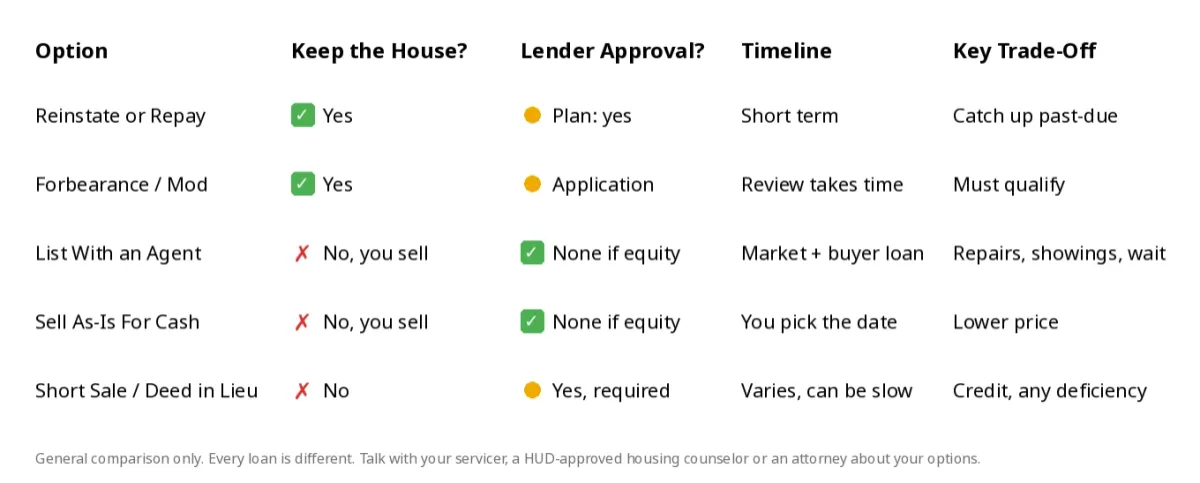
The CFPB lists the options a servicer might make available as refinancing, a loan modification, a repayment plan, forbearance, a short sale or a deed-in-lieu of foreclosure (CFPB). The first four can keep you in the house; which ones you qualify for depends on your loan, the owner of the loan, your income and whether the hardship is temporary or permanent.
1. Reinstate the Loan
Reinstating means paying everything that is past due, usually the missed payments plus any late fees and costs, so the loan is current again. It can work when the hardship is over and you have savings, a tax refund, help from family or other funds to cover the full amount. Ask your servicer for a written reinstatement figure good through a specific date, because the amount changes as more payments and fees come due.
Ask your servicer for:
- The exact amount needed to bring the loan current
- The date that amount is good through
- Where and how to send certified funds
- Written confirmation once the loan is current
2. Repayment Plan or Forbearance
These can help when the hardship is temporary, such as:
- A job loss or cut in hours
- An illness, injury or medical bills
- A divorce or death in the family
- A natural disaster or major home damage
A repayment plan spreads the past-due amount over several months on top of your regular payment. Forbearance pauses or reduces payments for a limited time, but the CFPB is clear that it does not erase or decrease what you owe: the missed amounts are repaid later, either all at once, over time or at the end of the loan, and interest may keep adding up (CFPB: What is mortgage forbearance?). Keep asking questions until you understand exactly how and when the paused amount comes due.
3. Loan Modification
A modification may make sense if:
- You can no longer afford the regular payment
- Your income has dropped for the long term
- You want to stay in the house for years
- You can document your income and expenses
4. Refinancing and Free Housing Counseling
The CFPB says a modification changes the terms of your loan, often adding missed payments to the balance, while a refinance replaces the loan with a new one and generally works best if you haven't missed recent payments (CFPB: Avoid Foreclosure). A HUD-approved housing counselor can review your situation, explain the options your servicer has and help with the paperwork at little or no cost. In New Mexico, United South Broadway Corporation is an Albuquerque-based, HUD-certified, state-sponsored counseling agency for homeowners behind on their mortgage. This page is general information, not legal or financial advice.
Helpful Resources:
What Happens After You Miss Mortgage Payments
Federal mortgage servicing rules set a general timeline for most home loans. The CFPB explains that your servicer must try to contact you by phone or in person by the 36th day you are behind and send a written notice by the 45th day describing loss mitigation options that may be available, and must assign you personnel to help (CFPB: Does my servicer have to help me?; 12 CFR 1024.39). In most cases, the legal foreclosure process can't start until you are more than 120 days behind (CFPB: The Foreclosure Timeline; 12 CFR 1024.41). Late fees, credit reporting and the exact steps depend on your loan documents and your servicer.
A typical timeline for a missed payment:
- Due date: the payment is missed and the account is behind
- After any grace period in your loan: a late fee may be charged
- By day 36: your servicer must try to reach you by phone or in person
- By day 45: a written notice describing possible loss mitigation options
- Days 45 to 120: a key window to apply for help or plan a sale
- After 120 days: a foreclosure complaint may be filed in district court
How federal rules describe early contact:
CFPB: Does My Mortgage Servicer Have To Help Me Avoid Foreclosure?
When foreclosure can start:
CFPB: How Long Before I Face Foreclosure?
The federal rule itself:
Applying to Your Servicer for Mortgage Help
Most options start with a loss mitigation application, the servicer's form for reviewing you for every option it has. The CFPB says that if you send a complete application before the foreclosure process starts, the servicer generally can't start it while your application is being reviewed (CFPB: How To Avoid Foreclosure). If a complete application is received more than 37 days before a scheduled sale, the servicer must review it and tell you in writing within 30 days which options, if any, you qualify for, and if it arrives 90 days or more before a sale, you can appeal a denied loan modification (CFPB: After I complete an application).
Tips homeowners often find useful:
- Apply early, before the account reaches 120 days behind
- Send every page and document the servicer asks for
- Keep copies and write down every call, date and name
- Read and answer every letter by its deadline
Documents servicers commonly ask for:
- Recent pay stubs or other proof of income
- Recent bank statements
- Your most recent tax returns
- A hardship letter explaining what happened
- A monthly budget of income and expenses
- Your latest mortgage statement
- Any letters you received from the servicer
New Mexico Judicial Foreclosure Basics
If the account stays behind, New Mexico is a judicial foreclosure state: the lender has to file a complaint in district court and prove it is entitled to take the property, the summons gives the homeowner 30 days to respond, the lender can ask for a default judgment if no answer is filed, and a case can take several months (NM Courts: Foreclosure Self-Help). For Albuquerque homes that is the Second Judicial District Court in Bernalillo County, and most of Rio Rancho is in Sandoval County, served by the Thirteenth Judicial District Court. The courts' Foreclosure Settlement Program helps homeowners and lenders work toward an agreement, and the courts say most of its cases end in loan modifications. After a court-ordered sale, New Mexico law generally gives the former owner nine months to redeem the property, though the mortgage can shorten that to as little as one month (NMSA 39-5-18; NMSA 39-5-19). Our New Mexico foreclosure guide covers the court case and sale stages in detail.
If you have been served with a complaint:
- Note the date you were served; the 30-day clock is short
- Read every page, including any program notices
- Contact a housing counselor or an attorney right away
- Keep talking with your servicer about your application
Read more:
NM Courts: Foreclosure Self-Help
Can You Sell a House You Are Behind On?
Yes, in most cases, and usually without asking your servicer for permission.
The CFPB says selling when the home is worth more than you owe (CFPB: Avoid Foreclosure):
- Is typically better for your money and credit than a foreclosure
- Is also typically better than a short sale or deed-in-lieu
- Doesn't need approval from your mortgage servicer
- Pays off the mortgage in full at closing
- Lets you keep the remaining funds after selling costs
Selling may still be possible even if:
- You are several payments behind
- Late fees and costs have been added to the balance
- Property taxes are also behind (selling with back taxes)
- The house needs repairs you cannot afford
- The utilities were cut off (selling with the water shut off)
- A complaint has already been filed in district court
Before you sell, ask your servicer for a written payoff statement so you know the exact amount needed to pay the loan off on a given date. Listing with an agent may bring a higher price if you have time for repairs, showings and a buyer's loan approval. Selling as-is for cash usually means a lower price than a fully updated house would bring, in exchange for no repairs, no showings and a closing date you choose, which can matter when the payments keep adding up. We meet sellers in person at the property, walk through it with you and go over the numbers, including your payoff.
Short Sales and Deeds in Lieu When You Owe More Than It Is Worth
If the house is worth less than the balance, a regular sale may not cover the payoff. In a short sale, the servicer agrees to accept less than you owe; you find the buyer, and you need the servicer's approval, plus approval from any second lender (CFPB: Avoid Foreclosure). The CFPB suggests asking the servicer to waive the remaining balance, called a deficiency, in writing (CFPB: What is a short sale?). A deed-in-lieu of foreclosure turns ownership over to the servicer so you can move out without selling the house yourself; you still need a complete loss mitigation application and approval, and it may mean you don't owe the remaining balance (CFPB: What is a deed-in-lieu?).
Things to ask before you agree:
- Will the remaining balance be waived in writing?
- How will it be reported to the credit bureaus?
- Does a second mortgage or other lien need to sign off?
- What tax questions should I ask a CPA?
- How long will the approval take?
If you are not sure whether you have equity, a payoff statement and an honest look at the house's as-is value can answer it. Our distressed property guide covers houses with other problems, and our title problems guide explains liens and recorded issues that can affect a sale.
Helpful resource:
Foreclosure Rescue Scam Warning Signs
The CFPB warns about these signs (CFPB):
- You are asked to pay upfront for help
- A company guarantees it will change your loan terms
- A company guarantees you won't lose your home
- You are asked to sign over title or sign papers you don't understand
- You are told to send payments to someone other than your servicer
- A company pushes a paid "forensic audit"
- You are told to stop paying your mortgage
Safer places to start include:
- Your mortgage servicer, using the number on your statement
- A HUD-approved housing counseling agency
- New Mexico Legal Aid or a private attorney
- The NM Courts Foreclosure Settlement Program if a case is filed
- A licensed title company to close any sale
- A real estate professional you have checked out
Keep the House, List It or Sell It As-Is?
If you are deciding, homeowners usually:
- Find out the exact past-due amount and the full payoff
- Ask a housing counselor which options fit their income
- Compare the house's as-is value with what is owed
- Add up the cost of repairs needed to list it
- Consult an attorney if a complaint has been filed
Keeping the house can make sense when the hardship is temporary and a reinstatement, repayment plan, forbearance or modification gets the payment back within reach. Listing with an agent may bring a higher price if there is time and equity to cover repairs, showings and a buyer's loan approval. A direct cash sale trades some of the top price for speed and simplicity: no repairs, no showings and a closing date you choose. If a job loss or medical bills caused the problem, our guides to selling after a job loss and selling because of medical bills may help.
Ethan is also a licensed New Mexico real estate broker, so he can walk you through the selling paths, while a housing counselor helps with servicer options and an attorney answers legal questions.
Albuquerque, Rio Rancho & New Mexico Mortgage Help Resources
Rules, courts and help homeowners may use:
Federal mortgage help: CFPB: Options If You Can't Pay · CFPB: Foreclosure Timeline · CFPB: Avoid Foreclosure · 12 CFR 1024.39: Early Intervention · 12 CFR 1024.41: Loss Mitigation
Counseling & courts: HUD: Find a Housing Counselor · United South Broadway Corporation · NM Courts: Foreclosure Self-Help · Foreclosure Settlement Program · NM Courts Case Lookup · NMSA 39-5-18: Redemption
Legal help: State Bar of New Mexico · New Mexico Legal Aid · Related guides: New Mexico Foreclosure Guide · Avoiding Bankruptcy
How Our Process Works · We Buy Houses in Albuquerque · Sell a House Fast in Rio Rancho · Contact Us
Important Reminder
Every homeowner and every loan is different.
How far behind you are, who owns your loan, your income, your equity and the condition of the house can all affect your price, timing and options.
The earlier you call your servicer, talk with a housing counselor and get good information, the more options you may have available.
FAQ
Can I sell my house in Albuquerque if I am behind on my mortgage?
Yes, in most cases. The CFPB says you don't need your servicer's approval to sell a home that is worth more than you owe; the mortgage is paid off at closing and you keep the remaining funds after selling costs. If you owe more than the house is worth, a short sale needs the servicer's approval.
How many missed payments before foreclosure starts?
Under federal rules, the legal process generally can't start until you are more than 120 days behind, with some exceptions. Your servicer must try to contact you by day 36 and send a written notice of possible options by day 45. In New Mexico, foreclosure then goes through a case in district court.
What is the difference between reinstatement, a repayment plan and forbearance?
Reinstatement means paying the full past-due amount at once to bring the loan current. A repayment plan spreads that amount over several months on top of your regular payment. Forbearance pauses or reduces payments for a limited time, but you still owe the paused amount later.
Will applying for a loan modification stop foreclosure?
It can help. The CFPB says that if you send a complete loss mitigation application before the foreclosure process starts, the servicer generally can't start it while the application is under review. Applying early, and sending every document requested, gives you the most protection. Ask a housing counselor or an attorney about your situation.
Is a short sale or a deed in lieu better than selling?
If you have equity, the CFPB says selling is typically better for your money and your credit than a foreclosure, short sale or deed-in-lieu. A short sale or deed-in-lieu is usually for owners who owe more than the house is worth, and both need the servicer's approval.
How does your process work if I am behind on payments?
Call (505) 300-2234 or send us the address. We meet sellers in person at their homes, so Ethan meets you at the house, walks through it with you and goes over your numbers, including your payoff and your other options. You don't need to make repairs first, and if a cash sale fits, you choose the closing date.
Ready To Talk About Your Options?
If the payments are falling behind and you are not sure whether to catch up or sell, understanding your options early can give you more choices and more control.
Some homeowners choose to:
- reinstate or set up a repayment plan
- apply for forbearance or a modification
- list the house with an agent
- skip repairs, updates and showings
- avoid waiting on a buyer's loan approval
- sell as-is for cash on their own timeline
Every situation is different, so talk with your servicer and a HUD-approved housing counselor, and consult an attorney if a complaint has been filed, before you decide.
Ready To Sell Your House Fast In Albuquerque?
Get a fair cash offer from a local Albuquerque home buyer.
No pressure. No obligation.
Follow Us


Other
We Help With
We Buy Houses In
This is not legal, financial, or tax advice. For specific answers tailored to your situation, we always recommend consulting your trusted professionals. Some members of NM Cash Offer LLC are licensed real estate brokers in the State of New Mexico. NM Cash Offer LLC does not represent any Sellers in this transaction unless a separate written listing agreement is executed. Click to see Broker Disclosure.
© Copyright 2026 NM Cash Offer LLC. All Rights Reserved.