
Selling an Inherited House in Albuquerque, New Mexico
Inheriting a house often comes with questions nobody planned for: who can sign, what to do with the belongings, whether the siblings agree and what the taxes look like. In New Mexico, probate is the court process that gives a person legal authority to handle a deceased person's affairs, and it is generally needed when real estate is titled only in the decedent's name (NM Courts: Probate Self-Help).
This guide is for heirs and beneficiaries who already have the house, or soon will. It explains how the house may have come to you, who can sign a sale, how co-heirs and out-of-state heirs usually handle it, what to do about belongings, the basic tax rule to take to a CPA, and how families in Albuquerque, Rio Rancho and nearby towns compare keeping, renting, listing or selling the house as-is for cash. For the court steps, see our New Mexico probate and inheritance guide, and if the death was recent, start with our guide to selling a house after a death.
This guide explains:
✅How the inherited house came to you
✅Who can sign the sale
✅Siblings and co-heirs who disagree
✅Selling when you live out of state
✅Cleaning out belongings
✅Stepped-up basis questions for a CPA
✅Keep, rent, list or sell as-is
Inherited a House? Let's Look at Your Options.
Whether you inherited the house on your own or with brothers and sisters, live across town or across the country, or are still sorting through a lifetime of belongings, we'll walk through your options at your pace and help you understand your next steps. Co-heirs and family members are welcome on the call or the visit, and there is no pressure to decide anything on the first call.
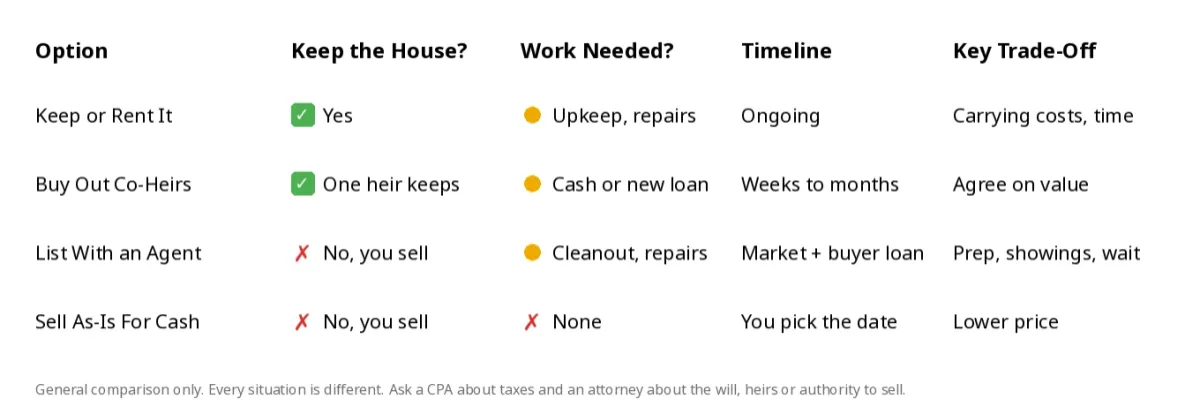
Options for an Inherited House
Some heirs move into the house or keep it as a rental. Others buy out a sibling's share, fix the house up and list it with an agent, or sell it as-is for cash, belongings and all. The right path depends on how title passed, who else inherited, the condition of the house, any loan or taxes owed, your own taxes and your family's goals.
1. Find Out How the House Came to You
How you inherited the house decides who can sell it and when. New Mexico's courts explain that real estate held in joint tenancy, or with a recorded transfer on death deed, passes outside probate, while real estate titled only in the decedent's name generally goes through probate (NM Courts: Probate Self-Help). A house held in a living trust is handled under the trust's terms. Our guide to selling a house after a death covers each of these title paths in more detail.
Things heirs often do first:
- Order several certified copies of the death certificate
- Find the will, any trust and the recorded deed
- Keep the insurance, utilities and property taxes paid
- List every heir and how to reach them
2. Know Who Can Sign the Sale
Questions heirs often ask:
- Can I sell before probate is finished?
- Do all of my siblings have to sign?
- What if there is no will?
- What if the house had a transfer on death deed?
If probate is opened, the court appoints a personal representative and issues Letters Testamentary (with a will) or Letters of Administration (without one), which give that person legal authority to act for the estate (NM Courts: Probate Self-Help). Unless the will or an order in a formal proceeding limits it, a personal representative acting reasonably for the people interested in the estate may sell estate land for cash at a public or private sale (NMSA 45-3-715). If no one has authority yet, the sale usually waits until the right person is appointed; our probate and inheritance guide explains the court steps.
3. Keep, Rent, Fix Up or Sell
Heirs often weigh things like:
- Whether anyone in the family wants to live there
- What it costs to carry the house each month while it sits
- A house with more repairs than anyone wants to take on
- How much equity is left after any home loan and liens
4. Taxes, Legal Help & Estate Questions
The IRS says the basis of property inherited from a decedent is generally its fair market value on the date of death, or on the alternate valuation date if the executor files an estate tax return and elects it, and that selling for more than your basis means a taxable gain (IRS: Gifts & Inheritances; IRS Publication 551). This is often called a stepped-up basis. Talk to a CPA about how it applies to you before you sell. For questions about the will, the heirs or authority to sell, consult an attorney. This page is general information, not legal, tax or financial advice.
Helpful Resources:
Selling an Inherited House With Siblings or Co-Heirs
When several people inherit one house, everyone who holds title, or the personal representative acting for the estate, generally has to be part of the sale. If co-owners cannot agree, New Mexico law lets an owner in joint tenancy or tenancy in common, including owners who received the property by will or by descent, ask the district court to divide the property, or to order a sale if it cannot be divided without great prejudice to the owners (NMSA 42-5-1). New Mexico also adopted the Uniform Partition of Heirs Property Act, which covers many family-owned houses where relatives hold the shares (NMSA 42-5A-2). Under that act, if a co-owner asks the court for a sale, the other co-owners get notice and 45 days to elect to buy that share at the court-determined value of the whole property times the share owned (NMSA 42-5A-7). Court cases take time and money, so many families try to agree on a plan first; consult an attorney about your situation.
Common reasons co-heirs disagree:
- One sibling wants to keep the house and the others want to sell
- One heir has been living in the house
- Different ideas about what the house is worth
- Who pays the taxes, insurance and utilities in the meantime
- Who handles the repairs and the cleanout
- Heirs spread across different states
Read the New Mexico partition law:
NMSA 42-5-1: Partition by Joint Tenants and Tenants in Common
Heirs property buyout rules:
NMSA 42-5A-7: Cotenant Buyout (Uniform Partition of Heirs Property Act)
Probate court forms:
Out-of-State Heirs and Selling From a Distance
Many Albuquerque houses go to children or relatives who live in another state. Probate is filed in the county where the decedent was living at the time of death, not where the heirs live, and the courts' self-help page says it can be filed in probate court any time between 5 days and 3 years after the death, with a current filing fee of $30, though some cases must be filed in district court instead (NM Courts: Probate Self-Help). In Bernalillo County that is the Bernalillo County Probate Court, and for a decedent who lived in Sandoval County, including most of Rio Rancho, it is the Sandoval County Probate Judge. Once appointed, a personal representative sends notice of the appointment to the heirs within 30 days and gathers and values the estate's assets within 3 months of appointment. Ask the title company how it handles signing for sellers who live out of state.
Distance makes it harder when:
- No one nearby can check on the house
- Mail, bills and notices go to an empty house
- Utilities and insurance need to stay on
- Repairs or a cleanout need someone on site
Papers that help when you sell an inherited house:
- Certified copies of the death certificate
- The will or trust, if there is one
- Letters Testamentary or Letters of Administration
- The recorded deed or transfer on death deed
- Recent property tax bills
- Statements for any loan on the house
- Contact details for every heir
Cleaning Out Belongings in an Inherited House
Furniture, photos, tools and other personal items usually do not have titles, and the courts' self-help page says probate is not needed to transfer untitled personal items. Still, if an estate is open, the personal representative is responsible for gathering and inventorying the decedent's assets and distributing them under the will or New Mexico's intestacy laws (NM Courts: Probate Self-Help), so heirs usually agree on who gets what before anything is removed, sold or donated. If the house is packed with decades of belongings, our guide to selling a hoarder house covers heavy cleanouts, a house sitting empty may fit our vacant and abandoned property guide, and if the utilities were cut off, see our page on selling a house with the water shut off.
What heirs often run into:
- Rooms full of furniture, papers and keepsakes
- Not knowing what has value and what does not
- Family members who want different items
- Older systems and repairs no one knew about
Helpful local resources:
Bernalillo County Probate Court
Selling an Inherited House As-Is in Albuquerque
Often, yes, once the right person has authority to sign.
Some New Mexico heirs choose a direct cash sale in order to:
- Sell without cleaning out every room first
- Skip repairs and updates on an older house
- Avoid months of showings while the house sits empty
- Avoid inspection repair requests and a buyer's loan approval
- Divide the proceeds among the heirs on a date that works
Selling may still be possible even if:
- Probate is still open
- Several heirs are on title
- You live out of state
- The house is vacant and needs work
- Property taxes have fallen behind (selling with back taxes)
- The house is still full of belongings
Selling as-is usually means a lower price than a cleaned-out, fully updated house would bring, in exchange for less work, fewer steps and a date you choose. Before the house is sold, the personal representative or the heirs on title should confirm they have authority to sign; consult an attorney if there is any question. We meet sellers in person at the property, walk through it with you and any co-heirs who want to join, and can work around the time your family needs to remove personal items.
Transfer on Death Deeds, Rio Rancho Homes and Inherited Rentals
A New Mexico transfer on death deed must have the elements of a recordable deed, state that the transfer happens at the owner's death, and be recorded with the county clerk before the owner's death (NMSA 45-6-409). The courts' self-help page says the beneficiary then files a copy of the death certificate with the county clerk where the property is located, and title goes to the beneficiary without probate (NM Courts: Probate Self-Help). In Bernalillo County, recorded documents are handled by the Bernalillo County Clerk. The same New Mexico probate rules apply to houses in Rio Rancho, Albuquerque and the rest of the state, and if you inherited a house that already had tenants, our New Mexico rental property selling guide covers leases and occupied sales.
Common issues include:
- A deed naming a beneficiary who has also died
- A will that does not match how the house is titled
- Tenants living in an inherited rental
- Old liens or recorded documents on title
- Heirs who cannot be found
If title has old liens or missing signatures, our title problems guide explains common fixes, and our probate and inheritance guide walks through informal and formal probate. If you inherited a rental and would rather sell it than keep managing it, read about selling a rental as a tired landlord.
Helpful resource:
Questions To Ask Before You Decide
Before keeping, renting, listing or selling, heirs usually think about:
- Who is on title now and who needs to sign
- Whether probate is needed or already open
- What every co-heir wants to do with the house
- What the house would sell for as-is and after repairs
- How much equity is left after any home loan and liens
- What it costs to carry the house each month
- What a CPA says about basis and taxes on the sale
Common sources of stress include:
- Coordinating siblings in different cities
- Bills and notices arriving at an empty house
- Deciding what to keep, give away or donate
- A distressed property that needs more work than anyone expected
- Title problems from old liens or missing signatures
- Not knowing what the house is worth as-is
Keep, Rent, Buy Out a Sibling or Sell?
If you are deciding, heirs usually:
- Add up a year of taxes, insurance, utilities and repairs
- Talk as a family about who wants to keep the house
- Ask a CPA about basis and taxes before selling
- Consult an attorney about authority to sell or disagreements
- Compare what the house would rent for with what it would sell for
Keeping the house can make sense when someone wants to live there or rent it out and can cover the upkeep. One heir buying out the others can keep it in the family, though it takes cash or a new loan and agreement on the value. If payments on a loan against the house have fallen behind, our guide for owners behind on payments explains the options. Listing with an agent may bring a higher price if the family can clean out the house, make repairs and wait for a buyer, while a direct cash sale trades some of the top price for speed and simplicity: no cleanout, no repairs, no showings and a closing date the heirs choose.
Ethan is also a licensed New Mexico real estate broker, so he can walk your family through the selling paths, while a CPA answers tax questions and an attorney answers estate and title questions.
Albuquerque, Rio Rancho & New Mexico Inherited Property Resources
Rules, offices and help heirs may use:
New Mexico law: NM Courts: Probate Self-Help · NMSA 45-3-715: Personal Representative Powers · NMSA 45-6-409: Transfer on Death Deeds · NMSA 42-5-1: Partition · NMSA 42-5A-2: Heirs Property · NMSA 42-5A-7: Cotenant Buyout
Courts, records & taxes: Bernalillo County Probate Court · Sandoval County Probate Judge · NM Courts: Probate Forms · Bernalillo County Clerk: Recording · IRS: Gifts & Inheritances · IRS Publication 551: Basis of Assets
Legal help: State Bar of New Mexico · New Mexico Legal Aid · Related guides: Probate and Inheritance Guide · Selling After a Death
How Our Process Works · We Buy Houses in Albuquerque · Sell a House Fast in Rio Rancho · Contact Us
Important Reminder
Every inherited house and every family is different.
How title passed, who else inherited, the condition of the house, any loans or unpaid property taxes and your tax picture can all affect your price, timing and options.
The earlier you sort out who can sign, talk with a CPA and get good information, the more options you may have available.
FAQ
Can I sell an inherited house in Albuquerque before probate is finished?
Often, yes. Once the court appoints a personal representative and issues Letters, that person has legal authority to act for the estate, and New Mexico law generally lets a personal representative sell estate land at a public or private sale unless the will or an order in a formal proceeding restricts it. Consult an attorney to confirm the authority in your case.
Do all of the heirs have to agree to sell the house?
It depends on how title is held. If an estate is open, the personal representative generally handles the sale for the estate. If the heirs already hold title together, each owner usually signs. When co-owners cannot agree, New Mexico law allows a court case to divide or sell the property, and under the Uniform Partition of Heirs Property Act the other co-owners get a chance to buy out a co-owner who asks for a sale. Many families try to agree on a plan first.
Can I sell an inherited house in New Mexico if I live out of state?
Yes, in many cases. Probate is filed in the county where the decedent lived, not where the heirs live, and much of the paperwork can be handled from a distance. Ask the title company how it handles signing for sellers who live out of state. We can meet a family member or someone you trust at the house if you cannot be there.
Do I have to clean out the house before selling it?
Not if you sell it as-is to a buyer who agrees to take it that way. Heirs usually take the photos, papers and family items they want first and agree among themselves who gets what. If an estate is open, the personal representative is responsible for gathering and inventorying the decedent's assets, so check with them before removing anything.
Will I owe taxes when I sell an inherited house?
It depends, so talk to a CPA before you sell. The IRS says the basis of inherited property is generally its fair market value on the date of death, often called a stepped-up basis, and you have a taxable gain if you sell for more than your basis. We do not give tax advice.
How does your process work if I want to sell an inherited house?
Call (505) 300-2234 or send us the address. We meet sellers in person at their homes, so Ethan meets you, and any co-heirs who want to join, at the house, walks through it with you and goes over your numbers and options. You don't need to clean it out or make repairs first, and if a cash sale fits, the person with authority to sign chooses the closing date.
Ready To Talk About Your Options?
If an inherited house is sitting empty, needs work or has several heirs who need to agree, understanding your options early can give your family more choices and more control.
Some heirs choose to:
- keep the house or rent it out
- buy out a sibling's share
- sell without cleaning out every room
- skip repairs, updates and showings
- avoid waiting on a buyer's loan approval
- sell as-is for cash on their own timeline
Every situation is different, so talk with a CPA about taxes and consult an attorney about the will, the heirs or authority to sell before you decide.
Ready To Sell Your House Fast In Albuquerque?
Get a fair cash offer from a local Albuquerque home buyer.
No pressure. No obligation.
Follow Us


Other
We Help With
We Buy Houses In
This is not legal, financial, or tax advice. For specific answers tailored to your situation, we always recommend consulting your trusted professionals. Some members of NM Cash Offer LLC are licensed real estate brokers in the State of New Mexico. NM Cash Offer LLC does not represent any Sellers in this transaction unless a separate written listing agreement is executed. Click to see Broker Disclosure.
© Copyright 2026 NM Cash Offer LLC. All Rights Reserved.