
Selling Your House Because of Medical Bills in Albuquerque
A hospital stay, a cancer diagnosis, a surgery or a long illness can change everything at once. The bills keep coming, you may be working less or not at all, and the house payment, insurance and upkeep do not stop, while the person who is sick needs all of the family's time and energy.
Whether the house is in Albuquerque, elsewhere in Bernalillo County, or in Rio Rancho and Sandoval County, questions like whether the bills are correct, what financial assistance you can get, whether a medical creditor can put a lien on your house, how New Mexico protects homeowners, and whether selling the house as-is makes sense are worth answering early. You usually have more than one path: get help with the bills and keep the house, borrow against it, list it, or sell it as-is for cash. This guide explains how each works so you can make a calm, informed decision.
This guide explains:
✅Checking medical bills and asking for financial assistance
✅New Mexico's Patients' Debt Collection Protection Act
✅Payment plans, negotiation and collections
✅Liens, judgments and the NM homestead exemption
✅Taxes when you sell for health reasons
✅Selling for a family member who is ill or in care
✅Selling the house as-is when it makes sense
Medical Bills Piling Up? Let's Look at Your Options.
Whether the bills come from an emergency, a long treatment or care for a family member, we'll walk through your options for the house at your pace and help you understand your next steps. Family members are welcome on the call or the visit, and there is no pressure to decide anything on the first call.
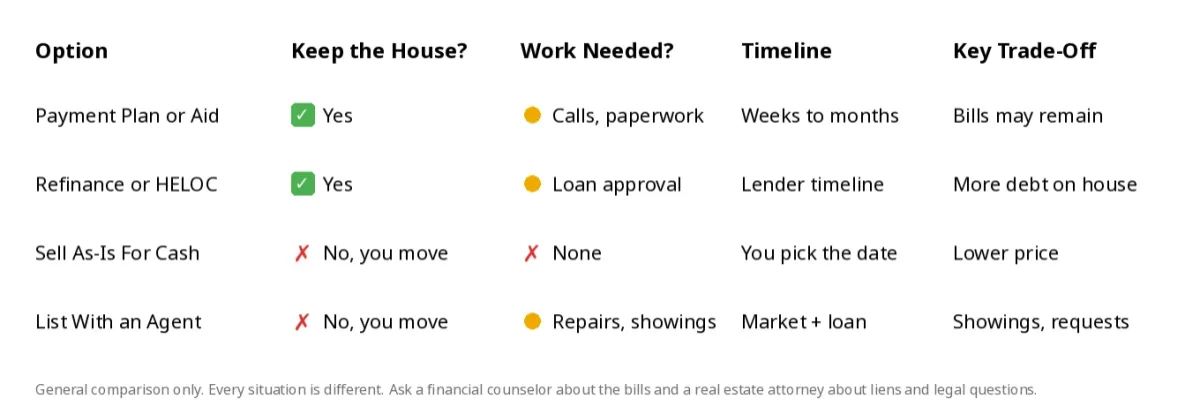
Options When Medical Bills Pile Up
Some owners get the bills reduced or spread out and keep the house. Others borrow against their equity, list the house with an agent, or sell it as-is for cash and use the proceeds to pay what they owe. The right path depends on how much you owe, your income and health, your equity, the condition of the house and your goals.
1. Check the Bills and Ask for Financial Assistance
Start before you pay anything large. The CFPB suggests asking for an itemized bill, checking it against your insurance explanation of benefits, and looking for errors such as duplicate charges or services marked out-of-network that were not (CFPB: What should I do if I can't pay a medical bill?). In New Mexico, health care facilities must, before seeking payment for emergency or medically necessary care, ask whether you have insurance and, if you are uninsured and ask, screen you for public coverage, other programs and the facility's own financial assistance. Most nonprofit hospitals must also have a written financial assistance policy under federal tax rules (IRS: Section 501(r)(4)).
Things owners often check first:
- Whether every charge on the itemized bill is correct
- What insurance paid and what is still being billed
- Whether they qualify for the hospital's financial assistance
- Whether Medicaid or another program could cover the care
2. Payment Plans, Negotiation & Collections
Ways local families handle it:
- Ask the billing office for an interest-free payment plan
- Ask whether the balance can be reduced
- Dispute a collection notice in writing if it looks wrong
- Think twice before moving the bills to a credit card
The CFPB notes that you can try to negotiate the bill down, ask about an interest-free repayment plan, and be careful with credit cards and medical credit cards, which can carry high interest and make the debt harder to negotiate. If a debt collector contacts you, a written dispute sent within 30 days of the validation notice generally requires the collector to stop collecting until it sends verification (CFPB: Disputing a debt). If the bill is for emergency care from an out-of-network provider, New Mexico's surprise billing protections may limit what you owe (NM OSI: Surprise Medical Bills).
3. Borrow Against the House, Keep It or Sell
Owners often weigh things like:
- Whether a refinance or home equity line of credit would turn bills into a larger loan backed by the house
- Whether their income can support another monthly payment during treatment
- A house with an old roof, worn systems or more repairs than they can take on right now
- Whether a smaller or one-level home would be easier to live in after treatment
4. Tax, Legal & Benefits Help
How medical debt, a judgment, a sale or a benefits program affects you depends on your situation. A real estate attorney can explain liens and title questions, a nonprofit financial counselor can help with a budget and the bills, and a tax professional can explain deductions: the IRS allows an itemized deduction for qualified medical and dental expenses above 7.5% of adjusted gross income (IRS Topic 502). This page is general information, not legal, tax or financial advice.
Helpful Resources:
New Mexico's Patients' Debt Collection Protection Act
New Mexico passed the Patients' Debt Collection Protection Act in 2021 (NMSA 1978, Chapter 57, Article 32; Senate Bill 71). It protects low-income patients, called indigent patients, whose household income is at or below 200% of the federal poverty guidelines. For these patients, medical creditors and medical debt collectors may not pursue collection actions, which the law defines to include selling the debt, filing a lawsuit, garnishing wages, seizing a bank account and placing a lien on the patient's property. You can ask your medical provider or the debt collector to determine whether you are indigent, and the Office of Superintendent of Insurance (OSI) publishes an Attestation of Indigency Form and an online tool to help (NM OSI: Patients' Debt Collection Protection Act). Under OSI's rules, an indigency determination is valid for 24 months (13.10.39 NMAC). Hospitals may also have their own programs with different income limits; for example, UNM Hospital's financial assistance program, UNM Care, has its own residency and income rules for New Mexico residents (UNM Hospital Financial Assistance Policy).
Common reasons Albuquerque owners fall behind on medical bills:
- An emergency room visit or hospital stay
- Cancer treatment or a long illness
- Surgery, rehab or physical therapy after an injury
- High deductibles and out-of-pocket costs
- Lost income while sick or caring for a family member
- Ongoing prescriptions, equipment or home care
Check whether you are protected as a low-income patient:
NM OSI: Patients' Debt Collection Protection Act
Apply for Medicaid (Turquoise Care) and other programs:
NM Health Care Authority: Apply for Benefits
Federal help with medical bills and billing rights:
Taxes When You Sell: Health-Related Moves & the Exclusion
If you sell your main home, IRS rules let you exclude up to $250,000 of gain from your income, or up to $500,000 for a married couple filing jointly, if you owned the house and lived in it as your main home for at least 2 of the 5 years before the sale and meet the other rules (IRS Publication 523). If you have to sell sooner, you may still qualify for a partial exclusion after a health-related move, such as moving to get or provide treatment or care for yourself or a family member, or when a doctor recommends a change in residence because of a health problem. If you itemize, qualified medical and dental expenses above 7.5% of adjusted gross income may be deductible, and money from the sale that is used to pay medical bills does not change how the sale itself is taxed. Ask a tax professional how the rules apply to you.
Tax questions often come up when:
- You sell before living in the house for 2 years
- You moved to be near treatment or to care for a family member
- A doctor recommended a different home for health reasons
- Part of the house was rented out or used for a business
Papers that help at tax time:
- The settlement statement from when you bought the house
- Receipts for additions, roofs, remodels and other improvements
- A doctor's note if the move was recommended for health reasons
- The settlement statement from the sale
- Receipts for medical and dental expenses you paid
- Insurance explanations of benefits for the year
- Notes from your tax professional
Liens, Judgments & the NM Homestead Exemption
Many owners worry that a hospital will take the house. Most nonprofit hospitals must make reasonable efforts to find out whether you qualify for financial assistance before taking extraordinary collection actions, which include selling the debt, reporting it to credit bureaus, suing, garnishing wages and placing a lien on your property. In general, the hospital must wait at least 120 days after the first bill after discharge and give at least 30 days' written notice first (IRS: Section 501(r)(6)). If a creditor does sue and wins a money judgment, a judgment recorded with the county clerk can become a lien on real estate in that county, and liens are usually paid or released at closing so the buyer gets clear title. New Mexico's homestead exemption protects up to $150,000 of a primary residence from execution by a judgment creditor under NMSA 1978, Section 42-10-9 as amended in 2023, but it does not apply to wage garnishment or to properly perfected liens held by lenders, such as your home loan (NMSA 42-10-9, NM Courts: Notice of Right to Exemptions). Ask a real estate attorney how any lien or judgment affects your sale.
What owners often run into:
- A collection lawsuit or court papers they have not answered
- A judgment lien that shows up on the title report
- Not knowing how much of their equity is protected
- Several bills from different providers and collectors
Helpful local resources:
Can You Sell Your House As-Is During a Health Crisis?
In many cases, yes.
Some New Mexico owners choose a direct cash sale in order to:
- Skip repairs, updates and staging while someone is sick
- Avoid months of showings and keeping the house spotless
- Avoid inspection repair requests and buyer loan approval
- Get the house off their plate so they can focus on care
- Pick a closing date that works around treatment
Selling may still be possible even if:
- The house has not been kept up during the illness
- The roof is near the end of its life and needs replacing
- There are cracks or foundation problems
- There are medical bills, collections or a judgment against the owner
- Property taxes have fallen behind (selling with back taxes)
- You have already moved in with family or into care
Selling as-is usually means a lower price than a fully updated house would bring, in exchange for less work, fewer steps and a date you choose. Known issues should still be disclosed in writing. We meet sellers in person at the house, walk through it with you and any family members you want there, and plan around treatment and appointments instead of the other way around.
Selling for a Family Member Who Is Ill or in Care
Many medical-bill sales are handled by a partner or adult children while the owner is in the hospital, in rehab or in long-term care. Whoever signs needs the legal authority to do it, such as the owner, the person managing the family trust, an agent under a valid power of attorney or a court-appointed conservator, and an attorney can confirm that before you list. If the owner may need Medicaid for long-term care, the New Mexico Health Care Authority handles applications, and how a sale and its proceeds affect eligibility depends on the program, so talk with an elder law attorney first (NM Health Care Authority: Turquoise Care).
Common issues include:
- Not knowing who has the authority to sign
- An owner who cannot leave the hospital or care facility
- Family members with different plans for the house
- Medical bills and household bills arriving at the same time
- Paying for care while the house sits empty
If the owner is retiring or moving somewhere smaller after treatment, our guide to selling your house to downsize may help. If the owner has already passed away, our guide to selling a house after a parent passes covers what usually comes next.
Helpful resource:
Questions To Ask Before You Decide
Before borrowing, listing or selling, owners usually think about:
- How much they really owe after errors and financial assistance
- Whether they qualify as a low-income patient under New Mexico law
- What the house would sell for as-is and after repairs
- How much equity they have after the home loan and any liens
- Where they will live and whether it fits their health needs
- Who in the family needs to agree or sign
- How the sale affects their taxes and benefits
Common sources of stress include:
- Calls and letters from collectors
- Bills from several providers for the same stay
- Strangers walking through the house during treatment
- A distressed house that needs more work than they can fund
- Worry that the debts will lead to bankruptcy
- Not knowing what the house is worth as-is
Keep the House or Sell It?
If you are deciding, owners usually:
- Get itemized bills and ask every provider about financial assistance
- Check whether they qualify under the Patients' Debt Collection Protection Act
- Talk with a HUD-approved housing counselor or a nonprofit financial counselor
- Ask a real estate attorney about any lawsuit, judgment or lien
- Compare the monthly cost of keeping the house with what it would sell for
Keeping the house can make sense when the bills can be reduced, covered or spread out and the house payment is still affordable. A refinance or home equity line may work if you have income and equity, but it puts more debt on the house. Listing with an agent may bring a higher price if you have the time and energy for repairs and showings, while a direct cash sale trades some of the top price for speed and simplicity: no repairs, no showings and a closing date you choose. The CFPB has a tool to find a HUD-approved housing counselor.
Ethan is also a licensed New Mexico real estate broker, so he can walk you through the selling paths, while your attorney, tax professional and financial counselor answer legal, tax and budget questions.
Albuquerque, Rio Rancho & New Mexico Medical Bill Resources
Offices and help owners and families may contact:
New Mexico: OSI Patients' Debt Collection Protection Act · OSI Surprise Medical Bills · OSI Consumer Assistance · 13.10.39 NMAC · NM Health Care Authority: Apply for Benefits · YES New Mexico · Assessors: Bernalillo County · Sandoval County
Federal: CFPB: Can't Pay a Medical Bill · CFPB: Medical Bills in Collections · CFPB: Debt Collection · CMS: Medical Bill Rights · IRS: Hospital Financial Assistance Policies · IRS: Hospital Billing & Collections · IRS Publication 523 · IRS Topic 502
Legal help: State Bar of New Mexico · Lawyer Referral for the Public · New Mexico Legal Aid
Important Reminder
Every family and every medical situation is different.
How much you owe, your income, your equity, the condition of the house, any liens or judgments and who needs to sign can all affect your price, timing and options.
The earlier you check the bills, ask for financial assistance and get good information, the more options you may have available.
FAQ
Can I sell my house as-is to pay medical bills in Albuquerque?
Yes. Many Albuquerque and Rio Rancho owners sell without making repairs, either by listing as-is with an agent or by selling as-is for cash. Known issues should be disclosed in writing, and any liens or judgments are usually paid from the sale proceeds at closing.
Can a hospital put a lien on my house in New Mexico?
It depends. Under New Mexico's Patients' Debt Collection Protection Act, medical creditors may not take collection actions, including liens, against patients with household income at or below 200% of the federal poverty guidelines. Most nonprofit hospitals must also check for financial assistance before liens or lawsuits. Ask a real estate attorney about your situation.
Does the New Mexico homestead exemption protect my house from medical debt?
It can help. NMSA 1978, Section 42-10-9 protects up to $150,000 of a primary residence from execution by a judgment creditor. It does not apply to wage garnishment or to properly recorded loans such as a home loan, so ask an attorney how it applies to you.
Should I ask about financial assistance before I sell?
Yes. New Mexico health care facilities must, on request, screen uninsured patients for public coverage, other programs and their own financial assistance before seeking payment for emergency or medically necessary care. Ask every provider for an itemized bill and a financial assistance application first.
Will I owe taxes if I sell early because of health problems?
Maybe not. IRS Publication 523 allows up to $250,000 of gain to be excluded, or $500,000 for a married couple filing jointly, if you meet the 2-of-5-year rules, and a partial exclusion may apply after a health-related move. Ask a tax professional about your situation.
How does your process work if someone in the family is sick?
Call (505) 300-2234 or send us the address. We meet sellers in person at their homes, so Ethan meets you and any family members at the house at a time that works around treatment, walks through it with you, and goes over your numbers and options. You don't need to make repairs first, and if a cash sale fits, you choose the closing date.
Ready To Talk About Your Options?
If medical bills, lost income or a health crisis are making the house hard to keep, understanding your options early can give you more choices and more control.
Some homeowners choose to:
- get help with the bills and keep the house
- sell without repairing the house first
- skip showings and open houses
- avoid waiting on a buyer's loan approval
- pay medical bills and liens from the sale at closing
- sell as-is for cash on their own timeline
Every situation is different, so talk with a real estate attorney or financial counselor about legal and financial questions before you decide.
Ready To Sell Your House Fast In Albuquerque?
Get a fair cash offer from a local Albuquerque home buyer.
No pressure. No obligation.
Follow Us


Other
We Help With
We Buy Houses In
This is not legal, financial, or tax advice. For specific answers tailored to your situation, we always recommend consulting your trusted professionals. Some members of NM Cash Offer LLC are licensed real estate brokers in the State of New Mexico. NM Cash Offer LLC does not represent any Sellers in this transaction unless a separate written listing agreement is executed. Click to see Broker Disclosure.
© Copyright 2026 NM Cash Offer LLC. All Rights Reserved.